
Alamance County Criminal Docket Searches
Begin at the North Carolina eCourts Portal. Its Smart Search tool opens the underlying Case Summary. Enter the case number if you have it. Or search by party name with Location set to Alamance. Anyone can browse anonymously. Registering lets you save cases, but it grants no extra access to restricted material.
Always use the exact case number. The statewide Enterprise Justice format starts with a two-digit year, then case-type letters, a six-digit sequence, and a three-digit county identifier. The example 21CR000003-910 shows the format only; it is not an Alamance case number. A citation, a notice, or a live Portal result gives the number you can trust for the case at hand.
- Open Smart Search and use a case number or party name as the search criterion.
- Set the location to Alamance when the event occurred in Alamance County.
- Open the matching Case Summary after checking the case category and court context.
- Read Case Events, Hearings, and Dispositions as separate parts of the criminal docket.
- Contact the Clerk for a certified disposition or a document copy.
Alamance Criminal Docket Portal Cases
Smart Search answers the case-history question. Search Hearings answers the calendar question. Pick Alamance there. Choose Criminal when it fits. Set a date range, and search by case number, party, attorney, judicial officer, or courtroom. One caution applies: a past setting can linger in a Case Summary after the next hearing has moved, so read the hearing results beside the recent Case Events.
The Judicial Branch still lists an official Alamance criminal calendar endpoint, but it currently returns a 403 error. Treat the Portal and the Clerk as your working tools rather than any unofficial substitute. For a setting that matters soon, call the criminal courthouse at 336-570-5202, or the unified Clerk line at 336-570-5200. The Judicial Branch criminal-calendar endpoint carries the county's official criminal calendar.
It shows the local split between the county calendar route and the Portal's hearing search.
Criminal Dockets: What They Show
Think of an Alamance criminal Case Summary as a near-real-time index. It is not an automatic certified copy. It does not display every filed image. The header may carry Case Information and Assignment Information. Where public access allows, more sections can appear. Party Information, Case Events, Hearings, Dispositions, and Financial Information may show up too. Do not assume a charge field or a document view from a summary alone.
| Case number | The system identifier and court context; use the actual Portal result or court notice. |
|---|---|
| Case Events | Chronological activity such as charge, first appearance, motion, continuance, plea, or order. |
| Hearings | Scheduled setting information, best checked against Search Hearings for the current date. |
| Dispositions | Recorded outcomes when entered. A pending event and a disposition are not the same thing. |
| Financial Information | Case-level amounts when applicable, not a substitute for a court outcome or another agency record. |
Read the panels in order. Case Events tell you what happened, Hearings tell you what is set, and Dispositions record an outcome once one has been entered.
Alamance Criminal Docket Hearing Checks
A continuance moves a hearing. It does not resolve anything. When the latest event mentions a change, open Search Hearings. Pull the current date range. Compare it with recent Case Events. Remote-hearing instructions, a new order, or a later calendar action can all shift what you actually need to do. The Portal calendar is current, but confirm directly when an appearance is imminent.
For Superior Court scheduling, the published Trial Court Coordinator number is 336-570-5216. The District Court Judges office is 336-570-5212. Those lines can point you to the right division, though they do not replace the Case Summary or a Clerk-issued copy. Note: an older hearing entry can explain the case history, but it does not mean that date is still the next setting.
Criminal Case Stages on the Docket
A North Carolina criminal case can start with investigation, arrest, or charge. From there the docket may show first appearance. Bond review can follow. A probable-cause step in a felony matter, indictment where applicable, plea, trial, sentencing, and appeal may come later. The exact wording comes from the live case. That sequence helps you place an entry without guessing at an Alamance code glossary. Treat it as a map, not a script.
Criminal process: Filing → Arraignment → Pretrial → Plea or Trial → Disposition → Sentencing
North Carolina's criminal-cases information walks through the statewide criminal process from start to finish.
That staging is why one criminal case can carry several docket settings before any final disposition appears.
Alamance Criminal Docket Appeal Changes
Misdemeanors and infractions, including traffic, usually begin in District Court. Felony trials sit in Superior Court. A felony can pass through preliminary District Court activity first. A misdemeanor or infraction appeal from District Court goes to Superior Court. That trial is brand new. That later matter is its own docket layer. It is not a fresh line on that file. Before calling two results duplicates, compare the location, case number, category, and latest event. The Judge J.B. Allen Jr. Criminal Courthouse page lists the local criminal-court location and its contact channel.
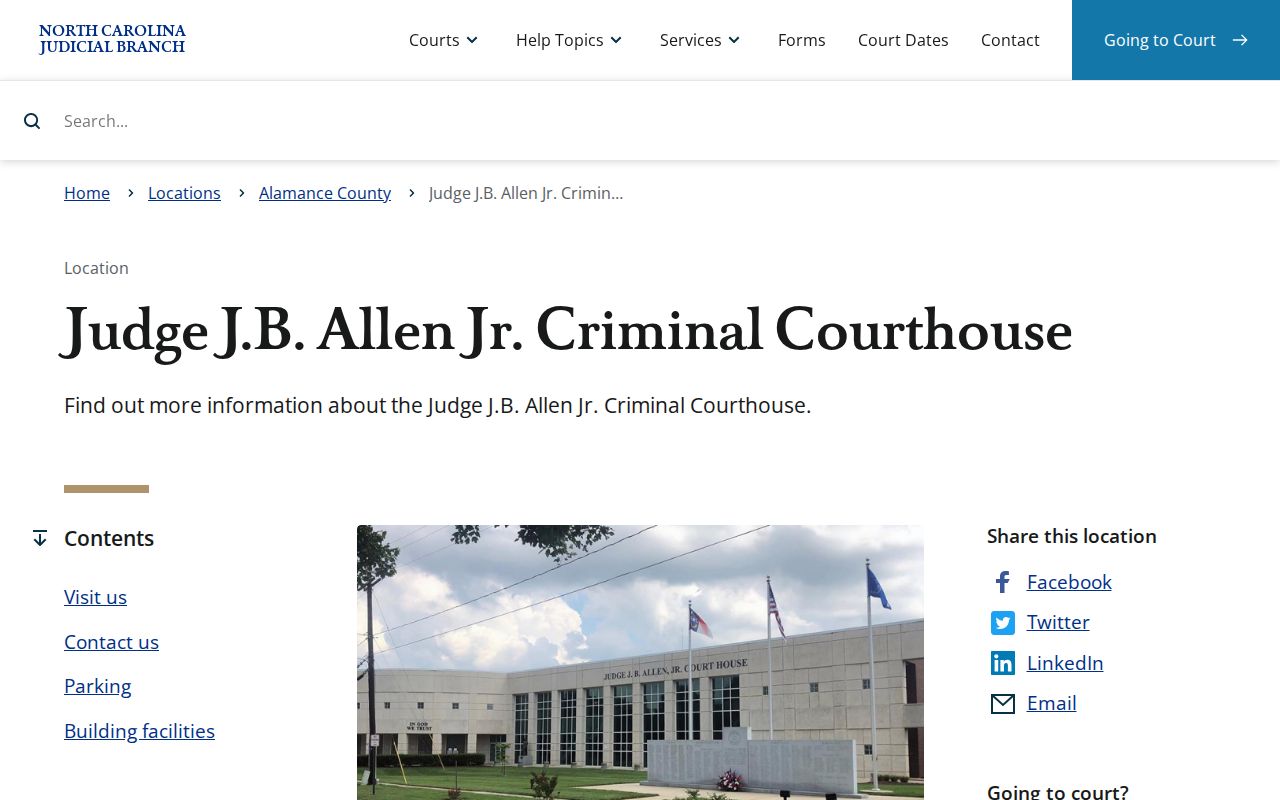
The courthouse is the physical front door for criminal court. The Alamance Clerk remains the unified keeper of the court record.
Alamance County Criminal Docket Courts
Criminal cases in Alamance County live in one place on paper. The keeper is the Clerk of Superior Court. That office holds the records for both District and Superior Court. There is no separate city clerk, even though the two courts do different work. District Court takes misdemeanors, infractions, and traffic matters. Superior Court handles felony trials. It also takes de novo appeals when someone contests a District Court misdemeanor or infraction outcome. All of it happens at 212 W. Elm Street in Graham.
Magistrates handle preliminary criminal functions within the District Court structure. So a criminal docket search should focus on the case, the court layer, and the current setting. Skip the hunt for a city-run criminal docket. The Alamance County court hub pulls together the county's official court and clerk resources in one spot.
Alamance Criminal Docket FTA Status
Missed a court date in Alamance County? District 17 has an order, effective October 1, 2024, that lets designated clerks strike first-time FTA status in qualifying pending criminal or infraction District Court cases. It is not an automatic dismissal. It also does not wipe away every missed setting. Before assuming anything, check the current Case Summary and the hearing entry. Then call the criminal court or the Clerk and ask what the court wants: an order, an appearance, a payment, a motion, or proof of some kind.
Current-status point: A first-time FTA policy is case-specific. Do not rely on an older docket entry before confirming the present court instruction.
Access Rules for Criminal Dockets
North Carolina law puts the Clerk in charge of records, files, dockets, and indexes. Those must stay open for public inspection. Regular office hours apply unless another law says otherwise. Online, Portal is the first stop for an Alamance County court docket. What about a public document that never appears there? A public terminal, an eCourts kiosk, or the paper file at the Clerk's office is the right fallback. One caution applies to certified copies. A certified disposition comes from the Clerk, never from a screen print.
Access rules:
G.S. 7A-109 requires Clerk record keeping and provides the public-inspection baseline, subject to legal limits.
G.S. 7B-3001 restricts juvenile records unless the statute or a court order permits access.
General Rules of Practice govern private filing information and the process for sealed material.
Alamance Criminal Docket Documents
A missing Portal image does not mean a document is missing. Material can be public yet classified Public not Portal. It may be restricted by law or sealed by order. Some items are reachable only through a courthouse device. Others open only to someone legally entitled to them. Search the case again with the right county and the exact case number. Then take any lawful access question to the Clerk's counter or public terminal.
The state court-records guidance says staff may make copies for a fee. Paper files are viewed at the Clerk office in the county where the case sits. When you ask, name the document, the case number, and the copy type you want. The published state fee chart lists $2.00 for the first prepared copy page and $0.25 for each additional page. A certificate under seal costs $3.00. An exemplification is $10.00. The Clerk confirms availability and the final total before you pay.
Be careful with the gap between a case event and the document behind it. A Case Event may say an order, notice, or disposition was entered. But the wording on the actual item, and whether the public can see it, are separate questions. Want the official court-issued result? Ask the Alamance Clerk for the specific document or a certified disposition. Do not treat a Portal display as the copy of record. That habit also prevents misreading a case with several charges, a later appeal entry, or a hearing that changed after an earlier event.
There is more than one fallback for local access. A reader who cannot find a current criminal result online has moves left. Confirm the spelling and number. Choose Alamance in Portal. Run Search Hearings for the present date range, then call the criminal courthouse line. For an older matter or one with no public image, the Clerk's public terminal and the paper-file channel still matter. And a restricted, juvenile, sealed, or redacted record calls for the access process the law allows, not a broader public search account.